Wednesday, February 27, 2013

Rishabha, the first Jain tirthankara
Jainism (pronounced [dʒɛːnɪzəm][citation needed]), traditionally known as Jaina dharma, is an Indian religion that prescribes a path of non-violence towards all living beings. It is one of the oldest religions of the world finding its roots in ancient India.[1] Tradition says that this belief has been preached by a succession of twenty-four propagators of faith known as tirthankara. Jainism emphasises spiritual independence and equality between all forms of life. Practitioners of this religion believe that non-violence and self-control is the means by which they can obtain liberation from the cycle of reincarnations.
Jainism is a religious minority in India, with 4.2 million followers, and has adherents in immigrant communities in Belgium, the United States, Hong Kong, Japan and Singapore.[2] Jains have the highest degree of literacy for a religious community in India,[3] and their manuscript libraries are the oldest in the country.[4]


Source:wikipedia.org
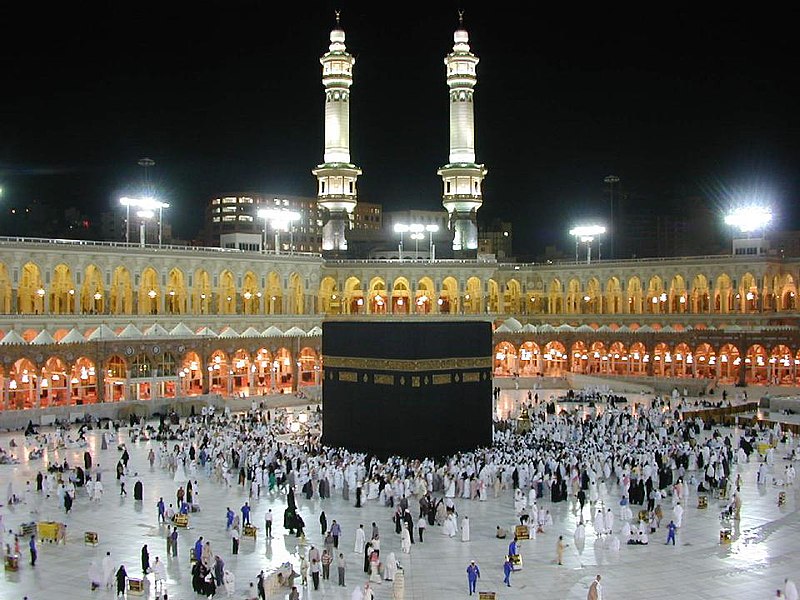
Islam (English pron.: /ˈɪzlɑːm/;[note 1] Arabic: الإسلامal-ʾislām  IPA: [ælʔɪsˈlæːm] ( listen)[note 2]) is a monotheistic and Abrahamic religion articulated by the Qur'an, a text considered by its adherents to be the verbatim word of God (Arabic: اللهAllāh) and by the teachings and normative example (called the Sunnah and composed of Hadith) of Muhammad, considered by them to be the last prophet of God. An adherent of Islam is called a Muslim.
Muslims believe that God is one and incomparable and the purpose of existence is to love and serve God.[1] Muslims also believe that Islam is the complete and universal version of a primordial faith that was revealed at many times and places before, including through Abraham, Moses and Jesus, whom they consider prophets.[2] They maintain that the previous messages and revelations have been partially misinterpreted or altered over time,[3] but consider the Arabic Qur'an to be both the unaltered and the final revelation of God.[4] Religious concepts and practices include the five pillars of Islam, which are basic concepts and obligatory acts of worship, and following Islamic law, which touches on virtually every aspect of life and society, providing guidance on multifarious topics from banking and welfare, to warfare and the environment.[5][6]
Most Muslims are of two denominations, Sunni (75–90%),[7] or Shia (10–20%).[8] About 13% of Muslims live in Indonesia,[9] the largest Muslim-majority country, 25% in South Asia,[9] 20% in the Middle East,[10] and 15% in Sub-saharan Africa.[11] Sizable minorities are also found in China, Russia, and the Americas. Converts and immigrant communities are found in almost every part of the world (see Islam by country). With about 1.57 billion followers or 23% of earth's population,[11][12][13] Islam is the second-largest religion and one of the fastest-growing religions in the world.[14][15][16][17][18][19][20]


File:Kaaba at night.jpg 

 Source:wikipedia.org


mp to: navigation, search
Confucianism
Dacheng Hall.JPG
The Dacheng Hall, the main hall of the Temple of Confucius in Qufu
Chinese
Confucianism is an ethical and philosophical system developed from the teachings of the Chinese philosopher Confucius (孔夫子 Kǒng Fūzǐ, or K'ung-fu-tzu, lit. "Master Kong", 551–479 BC). Confucianism originated as an "ethical-sociopolitical teaching" during the Spring and Autumn Period, but later developed metaphysical and cosmological elements in the Han Dynasty.[1] Following the abandonment of Legalism in China after the Qin Dynasty, Confucianism became the official state ideology of the Han. The disintegration of the Han in the second century C.E. opened the way for the spiritual and otherworldly doctrines of Buddhism and Daoism to dominate intellectual life and to become the ruling doctrines during the Tang dynasty. In the late Tang, Confucianism absorbed many of these challenging aspects and was reformulated Neo-Confucianism. This reinvigorated form was adopted as the basis of the imperial exams and the core philosophy of the scholar official class in the Song dynasty. Neo-Confucianism turned into sometimes rigid orthodoxy over the following centuries. In popular practice, however, the three doctrines of Confucianism, Buddhism, and Daoism were often melded together. The abolition of the examination system in 1905 marked the end of official Confucianism. The New Culture intellectuals of the early twentieth century blamed Confucianism for China's weaknesses. They searched for imported doctrines to replace it, such as the "Three Principles of the People" with the establishment of the Republic of China, and then Communism under the People's Republic of China. In the late twentieth century, Confucianism was credited with the rise of the East Asian economy and revived both in the People's Republic and abroad.
The core of Confucianism is humanism, or what the philosopher Herbert Fingarette calls "the secular as sacred." The focus of spiritual concern is this world and the family, not the gods and not the afterlife. [2] Confucianism broadly speaking does not exalt faithfulness to divine will or higher law. [3] This stance rests on the belief that human beings are teachable, improvable and perfectible through personal and communal endeavor especially self-cultivation and self-creation. Confucian thought focuses on the cultivation of virtue and maintenance of ethics, the most basic of which are ren, yi, and li.[4] Ren is an obligation of altruism and humaneness for other individuals within a community, yi is the upholding of righteousness and the moral disposition to do good, and li is a system of norms and propriety that determines how a person should properly act within a community.[4] Confucianism holds that one should give up one's life, if necessary, either passively or actively, for the sake of upholding the cardinal moral values of ren and yi.[5]
Cultures and countries strongly influenced by Confucianism include mainland China, Taiwan, Korea, Japan and Vietnam, as well as various territories settled predominantly by Chinese people, such as Singapore. Although Confucian ideas prevail in these areas, few people identify themselves as Confucian,[6] and instead see Confucian ethics as a complementary guideline for other ideologies and beliefs, including democracy,[7] Marxism,[8] capitalism,[9] Christianity,[10] Islam[11] and Buddhism.[12]


File:Konfuzius-1770.jpg

Source : wikipedia.org


 Buddhism


The founder of Buddhism in this world was Buddha Shakyamuni who lived and gave teachings in India some two and a half thousand years ago. Since then millions of people around world have followed the spiritual path he revealed.

The Buddhist way of life of peace, loving kindness and wisdom can be just as relevant today as it was in ancient India.

Buddha explained that all our problems and suffering arise from confused and negative states of mind, and that all our happiness and good fortune arise from peaceful and positive states of mind.


 Source : www.meditateinlondon.org.uk/buddhism


 Hinduism
 
Hinduism is the religion of the majority of people in India and Nepal. It also exists among significant populations outside of the sub continent and has over 900 million adherents worldwide.
Unlike most other religions, Hinduism has no single founder, no single scripture, and no commonly agreed set of teachings. 


Source : BBC.CO.UK

Types of internet Connection ?

While technology changes at a rapid pace, so do Internet connections. The connection speeds listed below is a general snapshot, representing general average to maximum speeds at the time of publication.

As technology grows, so does our need for bigger, better and faster Internet connections. Over the years the way content is presented via the Web has also changed drastically.Ten years ago being able to center, bold, and produce text in different colors on a webpage was something to admire.  Today, Flash,  animations, online gaming, streaming HD video, database-driven websites, ecommerce and mobile applications—to name but a few—are standards.
The need for speed has changed the options available to consumers and businesses alike in terms of how and how fast we can connect to the Internet.  The connection speeds listed below represent a snapshot of general average to maximum speeds at the time of publication. This is no doubt will change over time and Internet connection speeds also vary between Internet Service Providers (ISP).


 Source:  webopedia

Two types of cOmputer networks ?


A computer network, or simply a network, is a collection of computers and other hardware interconnected by communication channels that allow sharing of resources and information.[1] Where at least one process in one device is able to send/receive data to/from at least one process residing in a remote device, then the two devices are said to be in a network. A network is a group of devices connected to each other. Networks may be classified into a wide variety of characteristics: the medium used to transport the data, communications protocol used, scale, topology, benefit, and organizational scope.
Communication protocols define the rules and data formats for exchanging information in a computer network, and provide the basis for network programming. Well-known communications protocols include two Ethernet, a hardware and link layer standard that is ubiquitous in local area networks, and the Internet protocol suite, which defines a set of protocols for internetworking, i.e. for data communication between multiple networks, as well as host-to-host data transfer, and application-specific data transmission formats.
Computer networking is sometimes considered a sub-discipline of electrical engineering, telecommunications, computer science, information technology or computer engineering, since it relies upon the theoretical and practical application of these disciplines.
 

Source: Wikipedia.org

What is Internet Used ?

What Is the Internet Used for? thumbnail 


The Internet can be accessed from virtually anywhere on earth.
The Internet is a continually growing organism of information that is constantly morphing into new ways of communicating. Whether you want to send a quick note to someone, buy the newest products or find old friends, the Internet is the place to go. 


Source: Ehow.com

what is internet ?

The Internet is a global system of interconnected computer networks that use the standard Internet protocol suite (TCP/IP) to serve billions of users worldwide. It is a network of networks that consists of millions of private, public, academic, business, and government networks, of local to global scope, that are linked by a broad array of electronic, wireless and optical networking technologies. The Internet carries an extensive range of information resources and services, such as the inter-linked hypertext documents of the World Wide Web (WWW) and the infrastructure to support email.
Most traditional communications media including telephone, music, film, and television are being reshaped or redefined by the Internet, giving birth to new services such as Voice over Internet Protocol (VoIP) and Internet Protocol Television (IPTV). Newspaper, book and other print publishing are adapting to Web site technology, or are reshaped into blogging and web feeds. The Internet has enabled and accelerated new forms of human interactions through instant messaging, Internet forums, and social networking. Online shopping has boomed both for major retail outlets and small artisans and traders. Business-to-business and financial services on the Internet affect supply chains across entire industries.
The origins of the Internet reach back to research of the 1960s, commissioned by the United States government to build robust, fault-tolerant, and distributed computer networks. The funding of a new U.S. backbone by the National Science Foundation in the 1980s, as well as private funding for other commercial backbones, led to worldwide participation in the development of new networking technologies, and the merger of many networks. The commercialization of what was by the 1990s an international network resulted in its popularization and incorporation into virtually every aspect of modern human life. As of June 2012, more than 2.4 billion people—over a third of the world's human population—have used the services of the Internet.[1]
The Internet has no centralized governance in either technological implementation or policies for access and usage; each constituent network sets its own policies. Only the overreaching definitions of the two principal name spaces in the Internet, the Internet Protocol address space and the Domain Name System, are directed by a maintainer organization, the Internet Corporation for Assigned Names and Numbers (ICANN). The technical underpinning and standardization of the core protocols (IPv4 and IPv6) is an activity of the Internet Engineering Task Force (IETF), a non-profit organization of loosely affiliated international participants that anyone may associate with by contributing technical expertise.


File:Internet map 1024.jpg


Source: Wikipedia.org