mp to:
navigation,
search
| Part of a series on |
| Confucianism |
 |
|
|
Concepts in Confucian Thought[show]
|
|
|
|
|
|
|
|
|
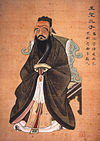
Confucianism is an ethical and philosophical system developed from the teachings of the Chinese philosopher
Confucius
(孔夫子 Kǒng Fūzǐ, or K'ung-fu-tzu, lit. "Master Kong", 551–479 BC).
Confucianism originated as an "ethical-sociopolitical teaching" during
the
Spring and Autumn Period, but later developed metaphysical and cosmological elements in the
Han Dynasty.
[1] Following the abandonment of
Legalism in China after the
Qin Dynasty,
Confucianism became the official state ideology of the Han. The
disintegration of the Han in the second century C.E. opened the way for
the spiritual and otherworldly doctrines of
Buddhism and
Daoism to dominate intellectual life and to become the ruling doctrines during the
Tang dynasty. In the late Tang, Confucianism absorbed many of these challenging aspects and was reformulated
Neo-Confucianism. This reinvigorated form was adopted as the basis of the
imperial exams and the core philosophy of the
scholar official class in the
Song dynasty.
Neo-Confucianism turned into sometimes rigid orthodoxy over the
following centuries. In popular practice, however, the three doctrines
of Confucianism, Buddhism, and Daoism were often melded together. The
abolition of the examination system in 1905 marked the end of official
Confucianism. The
New Culture
intellectuals of the early twentieth century blamed Confucianism for
China's weaknesses. They searched for imported doctrines to replace it,
such as the "
Three Principles of the People" with the establishment of the
Republic of China, and then
Communism under the
People's Republic of China.
In the late twentieth century, Confucianism was credited with the rise
of the East Asian economy and revived both in the People's Republic and
abroad.
The core of Confucianism is
humanism,
or what the philosopher Herbert Fingarette calls "the secular as
sacred." The focus of spiritual concern is this world and the family,
not the gods and not the afterlife.
[2] Confucianism broadly speaking does not exalt faithfulness to divine will or higher law.
[3]
This stance rests on the belief that human beings are teachable,
improvable and perfectible through personal and communal endeavor
especially self-cultivation and self-creation. Confucian thought focuses
on the cultivation of virtue and maintenance of ethics, the most basic
of which are
ren,
yi, and
li.
[4] Ren is an obligation of
altruism and humaneness for other individuals within a community,
yi is the upholding of righteousness and the moral disposition to do good, and
li is a system of norms and
propriety that determines how a person should properly act within a community.
[4]
Confucianism holds that one should give up one's life, if necessary,
either passively or actively, for the sake of upholding the cardinal
moral values of
ren and
yi.
[5]
Cultures and countries strongly influenced by Confucianism include mainland
China,
Taiwan,
Korea,
Japan and
Vietnam, as well as various territories settled predominantly by
Chinese people, such as
Singapore. Although Confucian ideas prevail in these areas, few people identify themselves as Confucian,
[6] and instead see Confucian ethics as a complementary guideline for other ideologies and beliefs, including
democracy,
[7] Marxism,
[8] capitalism,
[9] Christianity,
[10] Islam[11] and
Buddhism.
[12]

Source : wikipedia.org

 Jainism portal